Russian President Boris Yeltsin welcoming guests and participants in a New Year performance, the State Kremlin Palace.08.01.1996#768182
Leningrad TV anchor of "600 Seconds" program Alexander Nevzorov being received by Major-General Mikhail Mikhailov, head of the Leningrad criminal police, investigating the circumstances of an attack on the journalist on December 13, 1990.14.12.1990#773174
Leningrad TV anchor of "600 Seconds" program Alexander Nevzorov being received by Major-General Mikhail Mikhailov, head of the Leningrad criminal police, investigating the circumstances of an attack on the journalist on December 13, 1990.14.12.1990#773173
An alternative demonstration on November 7, 1990. Organized by Zelenograd voters' committee "Democratic Election," the Russian Christian Democratic Party, the Democratic Party of Russia, and a group of people's deputies.07.11.1990#773165
A public rally was held in Staraya Square on May 7, 1990 by the Moscow voters union, by the organizing committee of the Democratic Russia movement, by the social democratic party of Russia and by the Democratic Platform, making no part of the CPSU.07.11.1990#773161
US Secretary of Defense Richard Cheney (third right) visiting the 106th Guards Airborne Division in the Tula Region during a visit to the USSR as head of a US government delegation.16.10.1990#8309823
Moscow residents actively debate national developments near the building of the Moscow news editorial office. Samizdat publications hanging on the building's wall always rivet the attention of local dwellers.14.10.1990#6651132
Norway Days in Ukraine. Kiev residents receive a Norwegian delegation headed by the Arne Kokwold, the mayor of the mining town of Roros. Members of the delegation view St Andrew's Church (from 1968 to 2008 it served as a museum, then it was transferred to the Ukrainian Autocephalous Orthodox Church. The church was built i 1747-1753 in the style of Elizabethan baroque after Bartolomeo Rastrelli's design on St Andrew's Hill. The road from the church connects the upper town with its lower part, Kiev historical part called Podol. Ukrainian SSR.02.10.1990#6643024
Norway Days in Ukraine. Kiev residents receive a Norwegian delegation headed by the Arne Kokwold, the mayor of the mining town of Roros. Gunnar Gudmundsen, right, secretary-general of the Norway-USSR friendship society, presents a gift (a model of a viking ship) to Vasily Osnach, chairman of the Ukrainian friendship society, Ukrainian SSR.02.10.1990#6643016
On September 16, 1990, Moscow hosted an anti-government demonstration, with the protesters demanding that the Soviet Government resign and supporting the 500 Days program that stipulated a conversion to a free-market economy. Far right: People's Deputy of the RSFSR Sergei Yushenkov, Head of the Radical Democrats Parliamentary Party. Third right: Moscow Mayor Gavriil Popov. Fourth right: People's Deputy of the RSFSR Boris Nemtsov. In this photo, the protesters are marching on Zubovsky Boulevard.16.09.1990#8303054
An anti-government rally in Moscow, on September 16, 1990, demanding for the resignation of the Union government and in support of the 500 Days Market Transition Program. About 20,000 took part in the protest. Protestors on Krymsky Bridge.16.09.1990#8303543
An anti-government rally in Moscow, on September 16, 1990, demanding for the resignation of the Union government and in support of the 500 Days Market Transition Program. Manezhnaya Square during the rally.16.09.1990#8303531
An anti-government rally in Moscow, on September 16, 1990, demanding for the resignation of the Union government and in support of the 500 Days Market Transition Program. About 20,000 took part in the protest. Protesters on the Garden Ring and Krymsky Bridge.16.09.1990#8303529
An anti-government rally in Moscow, on September 16, 1990, demanding for the resignation of the Union government and in support of the 500 Days Market Transition Program. Protesters on the Garden Ring.16.09.1990#8303528
An anti-government rally in Moscow, on September 16, 1990, demanding for the resignation of the Union government and in support of the 500 Days Market Transition Program. A column of protesters is moving along Tverskaya Street towards Manezhnaya Square.16.09.1990#8303524
Asya Lashchiver, member of the liberal democratic faction of the Democratic Union party (leader of the party: Valeria Novodvorskaya).17.08.1990#8341644
Todor Zhivkov's forced resignation from the post of General Secretary of the Bulgarian Communist Party being followed by rallies and demonstrations. Sofia.10.01.1990#768277
In 1944, during the Great Patriotic War, Crimean Tatars were forcefully relocated from the Crimean Autonomous Soviet Socialist Republic to Uzbekistan, Kazakhstan and Tajikistan, based on several incidents of involvement of Crimean Tatars in collaborationist squads that fought on Nazi Germany's side and cooperation with occupationist authorities, although international law did not stipulate that an entire ethnic group can bear collective liability for actions of its members. In November 1989, the USSR Supreme Soviet recognized the deportation of Crimean Tatars in 1944 unlawful and criminal. The Crimean Tatars deported during the war started to return to their home region. Y.Ablyamitov works as a tractor operator. Ukrainian Soviet Socialist Republic. Crimean Region.27.12.1989#6558234
2nd Congress of People's Deputies of the USSR. Kremlin Palace of Congresses (now State Kremlin Palace), December 12 - December 24, 1989. Electronic vote counting system.24.12.1989#8253831
The People's Republic of Bulgaria. The civil protest Silent Presence in Sofia on the first day of the Plenary Meeting of the Central Committee of the Communist Party of Bulgaria. Local residents stood in silence on September 9 Square, so as to influence the decisions of the Plenary Meeting.11.12.1989#6650107
The civil action called "Silent presence": on the first day of the work of a Plenum of the Bulgarian Communist Party CC, people in Sofia silently gathered in September 9 Square to influence the decisions of the December Plenum of the BCP CC by their presence.11.12.1989#768271
The civil action called "Silent presence": on the first day of the work of a Plenum of the Bulgarian Communist Party CC, people in Sofia silently gathered in September 9 Square to influence the decisions of the December Plenum of the BCP CC by their presence.11.12.1989#768269
Live broadcast from the meeting of the Moscow city Komsomol committee by Soviet Central TV.10.12.1989#776696
Live broadcast from the meeting of the Moscow city Komsomol committee by Soviet Central TV.10.12.1989#776695
An official visit by Prime Minister of the Polish People's Republic Tadeusz Mazowiecki to the USSR. Tadeusz Mazowiecki, 2nd right, People's Deputy of the USSR and academician Andrei Sakharov, right, and People's Deputy of the USSR and Rector of the Moscow State Institute for History and Archives (now Russian State University for the Humanities) Yury Afanasyev, left, during the celebratory dinner.24.11.1989#6630472
A citywide party rally in Leningrad in November 1989 organized by the Soviet People's Deputy, First Secretary of the Leningrad Regional Communist Party Committee Boris Gidaspov. The Leningrad party leaders had concerns about perestroika, condemned the reforms policy and tried to reinstate the Communist Party authority. The slogans at the rally were "We will not let perestroika hit communism," "No anti-Leninism," "Gorbachev, pay attention to the party."22.11.1989#6622300
An anti-perestroika party rally in Leningrad in 1989, organized by Boris Gidaspov, USSR People's Deputy and First Secretary of the Leningrad Regional Committee of the Soviet Communist Party. Leningrad party leaders were particularly concerned with the process of perestroika, condemning the reforms and trying to restore the party's authority.22.11.1989#6747592
An anti-perestroika party rally in Leningrad in 1989, organized by Boris Gidaspov, USSR People's Deputy and First Secretary of the Leningrad Regional Committee of the Soviet Communist Party. Leningrad party leaders were particularly concerned with the process of perestroika, condemning the reforms and trying to restore the party's authority.22.11.1989#6747587
A human chain on Gorky Street (now Tverskaya Street) in Moscow, to defend the rights of Levon Gulyan, a witness in the case of mafia boss Stepan Vardanyan, who was killed in unconfirmed circumstances.14.11.1989#6724302
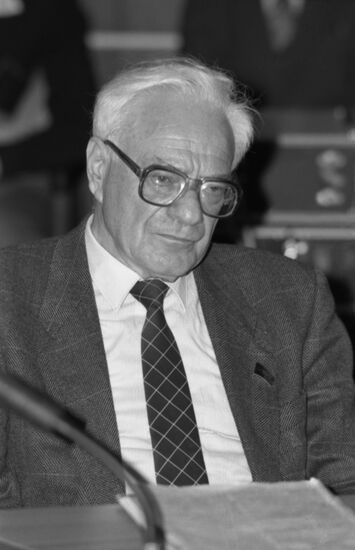
Mavriks Vulfsons, Soviet and Latvian journalist, politician and member of the USSR Supreme Soviet. In 1988, he was actively involved in founding the Latvian Popular Front.01.11.1989#6565243
In 1944, during the Great Patriotic War, Crimean Tatars were forcefully relocated from the Crimean Autonomous Soviet Socialist Republic to Uzbekistan, Kazakhstan and Tajikistan, based on several incidents of involvement of Crimean Tatars in collaborationist squads that fought on Nazi Germany's side and cooperation with occupationist authorities, although international law did not stipulate that an entire ethnic group can bear collective liability for actions of its members. In November 1989, the USSR Supreme Soviet recognized the deportation of Crimean Tatars in 1944 unlawful and criminal. The Crimean Tatars deported during the war started to return to their home region. An improvised camp of the relocatees. Ukrainian Soviet Socialist Republic. Crimean Region.27.10.1989#6558245
In 1944, during the Great Patriotic War, Crimean Tatars were forcefully relocated from the Crimean Autonomous Soviet Socialist Republic to Uzbekistan, Kazakhstan and Tajikistan, based on several incidents of involvement of Crimean Tatars in collaborationist squads that fought on Nazi Germany's side and cooperation with occupationist authorities, although international law did not stipulate that an entire ethnic group can bear collective liability for actions of its members. In November 1989, the USSR Supreme Soviet recognized the deportation of Crimean Tatars in 1944 unlawful and criminal. The Crimean Tatars deported during the war started to return to their home region. The relatives of E.Shapchi from Uzbekistan inquire about life in Crimea before deciding on returning to their ancestral territory. Ukrainian Soviet Socialist Republic.27.10.1989#6558244
In 1944, during the Great Patriotic War, Crimean Tatars were forcefully relocated from the Crimean Autonomous Soviet Socialist Republic to Uzbekistan, Kazakhstan and Tajikistan, based on several incidents of involvement of Crimean Tatars in collaborationist squads that fought on Nazi Germany's side and cooperation with occupationist authorities, although international law did not stipulate that an entire ethnic group can bear collective liability for actions of its members. In November 1989, the USSR Supreme Soviet recognized the deportation of Crimean Tatars in 1944 unlawful and criminal. The Crimean Tatars deported during the war started to return to their home region. At the same time, some members of the Crimean Tatar ethnic group started taking over plots of land without authorization, which the Crimean Tatars called voluntary recovery. Participants in the conflict. Ukrainian Soviet Socialist Republic. Crimean Region.27.10.1989#6558235
USSR Deputy Minister of Justice Vladimir Gubarev, left, and Observer of the Novosti Press Agency (today Rossiya Segodnya) Alexander Drabkin.26.10.1989#6633987
Deputy of the Seimas of the Polish People's Republic, Editor-in-Chief of Gazeta Wyborcza of the Solidarity trade union (published since 1989) Adam Michnik, a prominent Polish dissident, one of the opposition leaders in socialist Poland and adviser to the pro-democracy Solidarity movement.25.10.1989#6558222
Counting votes during a foundation conference of the Shield Russian Union of Social Protection of Military Personnel and Their Families (October 21-22, 1989).22.10.1989#6625924
The Solovetsky Forum public movement (1989) that focuses on the exoneration of political prisoners who were victims of the system and preserving the memory of those killed during the years of political repression. The first issue of the Trudovik newspaper published by the Solovetsky Correction Labor Camp.21.10.1989#6551977
Discussing the program during the foundation conference of the Shield Russian Union of Social Protection of Military Personnel and Their Families (October 21-22, 1989).21.10.1989#6625937
Member of the coordination council, retired colonel Vitaly Urazhtsev during a foundation conference of the Shield Russian Union of Social Protection of Military Personnel and Their Families (October 21-22, 1989).21.10.1989#6625920
Uzbek SSR. A rally on Lenin Square in Tashkent, organized by the Birlik (Unity) informal association, a right-wing opposition group and unregistered party that advocated Uzbekistan's independence from the USSR, democratic changes and Uzbek language as the official one.21.10.1989#8132538
Uzbek SSR. A rally on Lenin Square in Tashkent, organized by the Birlik (Unity) informal association, a right-wing opposition group and unregistered party that advocated Uzbekistan's independence from the USSR, democratic changes and Uzbek language as the official one.21.10.1989#8132536
General Secretary of the CPSU Central Committee, Chairman of the USSR Supreme Soviet Mikhail Gorbachev, third left, and member of the Politburo of the CPSU CC, Chairman of the USSR Council of Ministers Nikolai Ryzhkov, left, at the opening of the 1st national commercial exhibition of American companies USA-89.17.10.1989#855033
General Secretary of the CPSU Central Committee, Chairman of the USSR Supreme Soviet Mikhail Gorbachev, second right, and member of the Politburo of the CPSU CC, Chairman of the USSR Council of Ministers Nikolai Ryzhkov, fourth right, at the opening of the 1st national commercial exhibition of American companies USA-89. Chairman of the Presidium of the USSR Chamber of Commerce and Industry Vladislav Malkevich addressing the meeting.17.10.1989#855032
Spanish singer Julio Iglesias, an envoy of the UN Children's Emergency Fund (UNICEF) in Moscow, visits Moscow Children's Orphanage No.8 where children perform in a self-formed orchestra.04.10.1989#6555086
Viktor Girshenfeld, Representative of the Public Diplomacy Group at the Organizing Committee of the Moscow Popular Front, a local public-political organization that was established for overhauling the Soviet Union and which functioned in 1988-1990.03.10.1989#6566942
Margarita Bunkina, an economist working at the Institute of Social Sciences of the Soviet Communist Party Central Committee and author of textbooks for university students, including National Economy, Macroeconomics, Monetarism and others.03.10.1989#6566940
Alexei Yablokov, Soviet and Russian biologist, corresponding member of the USSR Academy of Sciences, a public and political figure. In 1989 he was elected People's deputy of the USSR by scientific societies and associations of the USSR Academy of Sciences and became deputy chairman of the Committee n the Environment of the Supreme Council of the USSR and member of the coordination council of the inter-regional group of deputies.21.08.1989#6546347
One of the first joint ventures in Russia, Sune Medical Interline Intermedservice, was established In Moscow. It supplies foreign medical equipment to Russia. As a result, the Swiss-Hungarian dental outpatient clinic Dentalcoop was opened in Moscow. The firm's director Mr. Tepli (right) with his business partners.01.08.1989#6542981
One of the first joint ventures, Sune Medical Interline Intermedservice, created in Moscow to supply foreign medical equipment to Russia. As a result, the Swiss-Hungarian dental clinic Dentalcoop opened in Moscow. Second right: Director of Dentalcoop T. Tepli.01.08.1989#6542976
Unauthorized rally of supporters of the Democratic Union party (led by Valeria Novodvorskaya) on Pushkin Square in Moscow. About 70 out of 300 protesters were arrested.23.04.1989#8253801
Tbilisi events or the Tragedy of April 8 imply a special operation to disperse an unauthorized opposition rally near the Government House of the Georgian SSR in Tbilisi in the early hours of April 9, 1989. The operation involved units of the Soviet Interior Ministry's troops and the Soviet Army. In all, 18 people were killed while clashing with government forces, and over 200 more were injured. Photo: |The funeral of victims of civil unrest.16.04.1989#6739252
Tbilisi events or the Tragedy of April 8 imply a special operation to disperse an unauthorized opposition rally near the Government House of the Georgian SSR in Tbilisi in the early hours of April 9, 1989. The operation involved units of the Soviet Interior Ministry's troops and the Soviet Army. In all, 18 people were killed while clashing with government forces, and over 200 more were injured. Photo: The funeral of victims of civil unrest.16.04.1989#6739244
Tbilisi events or the Tragedy of April 8 imply a special operation to disperse an unauthorized opposition rally near the Government House of the Georgian SSR in Tbilisi in the early hours of April 9, 1989. The operation involved units of the Soviet Interior Ministry's troops and the Soviet Army. In all, 18 people were killed while clashing with government forces, and over 200 more were injured. Photo: Laying flowers near the Government House in memory of the deceased.16.04.1989#6739243
Tbilisi events or the Tragedy of April 8 imply a special operation to disperse an unauthorized opposition rally near the Government House of the Georgian SSR in Tbilisi in the early hours of April 9, 1989. The operation involved units of the Soviet Interior Ministry's troops and the Soviet Army. In all, 18 people were killed while clashing with government forces, and over 200 more were injured. Photo: The funeral of victims of civil unrest.16.04.1989#6739242
Tbilisi events or the Tragedy of April 8 imply a special operation to disperse an unauthorized opposition rally near the Government House of the Georgian SSR in Tbilisi in the early hours of April 9, 1989. The operation involved units of the Soviet Interior Ministry's troops and the Soviet Army. In all, 18 people were killed while clashing with government forces, and over 200 more were injured. Photo: A soldier on a street in Tbilisi.12.04.1989#6739257
Tbilisi events or the Tragedy of April 8 imply a special operation to disperse an unauthorized opposition rally near the Government House of the Georgian SSR in Tbilisi in the early hours of April 9, 1989. The operation involved units of the Soviet Interior Ministry's troops and the Soviet Army. In all, 18 people were killed while clashing with government forces, and over 200 more were injured. Photo: Tbilisi residents on city streets.12.04.1989#6739240
Tbilisi events or the Tragedy of April 8 imply a special operation to disperse an unauthorized opposition rally near the Government House of the Georgian SSR in Tbilisi in the early hours of April 9, 1989. The operation involved units of the Soviet Interior Ministry's troops and the Soviet Army. In all, 18 people were killed while clashing with government forces, and over 200 more were injured. Photo: A police patrol receives instructions due to the declaration of a curfew following the tragic events of April 9.12.04.1989#6739239